This is the web page of PoLA project.
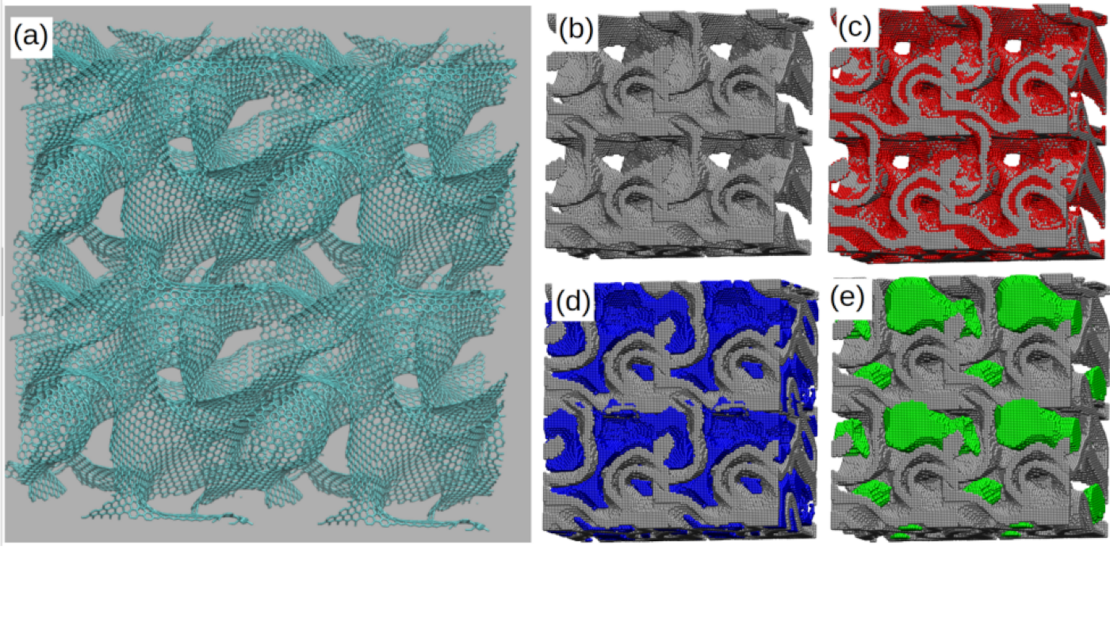
PoLA (Porosity Local Analysis) is a computational tool to analyze the inner structure of nanoporous materials: it can be applied either to atomistic models, or to real samples. PoLA is developed and maintained at the University of Eastern Piedmont (Italy): please cite it as indicated below.
To describe the local porosity of atomistic models, please follow the link to download the code and the instructions: PoLA can be aplied to models of any material, like amorphous carbons, zeolites, silica, MOF and others, only providing the atomic coordinates.
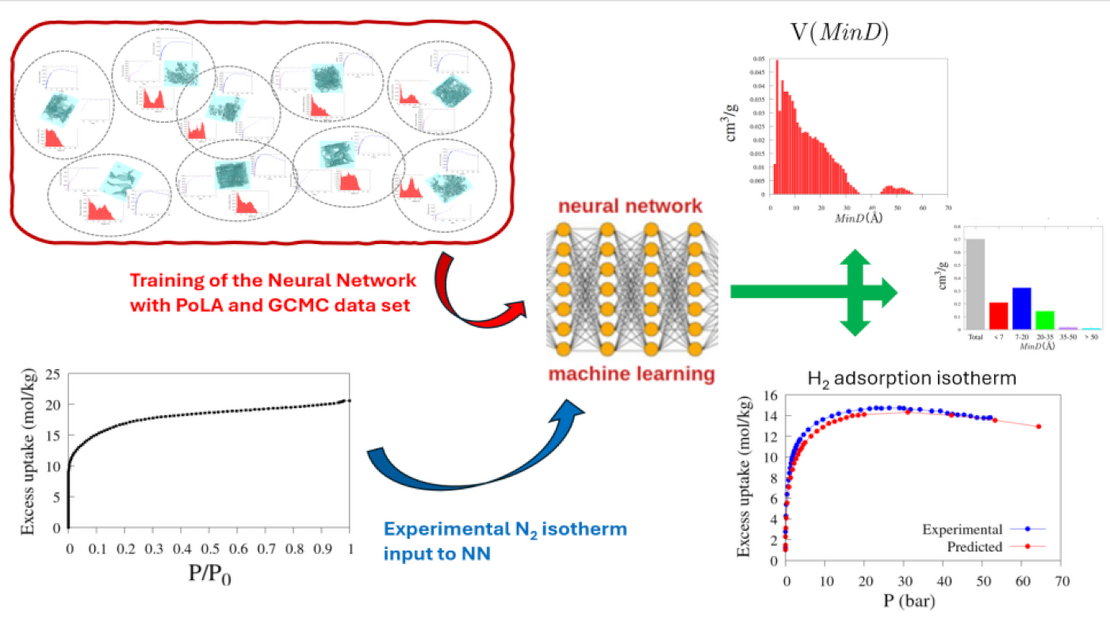
For real samples, PoLA uses a Neural Network machine learning algorithm (presently trained only for amorphous carbons): it requires the N2 excess adsorption isotherm at 77 K and outputs the analysis of the porous volume, along with a prediction of the H2 excess uptake at 77 K.
Porosity Local Analysis
the pore space seen from the inside
Traditional Description
(PSD / DFT)
Citations:
1) M. Cossi, A. Zoccante, V. Palumbo, M. D’Amore, F. Vallejos-Burgos, R. Kukobat, A. Moreo, F. Sebastiani, S. Brandani, E. Mangano, F. Begni, G. Celoria, L. Marchese
“Porosity Local Analysis (PoLA) for nanoporous carbons. Porous volume characterization and prediction of gas adsorption isotherms” Carbon 2026, DOI:10.1016/j.carbon.2026.121713
2) A. Zoccante, M. D’Amore, C. A. Guido, A. Fortunelli, G. Conter, L. Marchese, M. Cossi “Porosity Local Analysis (PoLA): A New Approach to Describe the Porous Volume Distribution in Amorphous Carbons” ACS Omega 2025, 10, 31623−31637.